I didn’t set out to become an author. I set out to handle life, which turned out to be a full-time job with terrible management and no instruction manual.
Meanwhile, stories kept showing up uninvited.
They arrived as strange ideas, impossible scenarios, half-formed characters, and questions that refused to leave me alone. What if a goblin moved into a suburban neighborhood? What if a haunted house had emotional baggage? What if a superhero was completely useless? What if two scientists fell in love while trying to understand the universe?
Most people would probably have these thoughts and then continue folding laundry.
I wrote books.
A lot of books.
More than thirty of them in less than two years, which is either evidence of remarkable dedication or a symptom that should probably be discussed with a medical professional.
Along the way, life threw a few plot twists of its own.
There were victories and setbacks. There were moments when everything seemed to be working and moments when it felt like the universe had accidentally misplaced the instruction manual. There was even a traumatic brain injury that changed my life overnight and forced me to rethink who I was, who I wanted to become, and how to keep moving forward when the road suddenly looked nothing like the map I’d been following.
That experience taught me something important.
Nothing is guaranteed.
Not time.
Not health.
Not tomorrow.
If you’re going to create something, create it now.
So I did.
I built an independent publishing company. I learned cover design, formatting, marketing, websites, advertising, crowdfunding, and approximately eight hundred other skills that nobody warns you you’ll need when you decide to become an author.
I made mistakes.
Spectacular mistakes.
The kind of mistakes that make excellent stories later.
And through it all, I kept writing.
Some of my books are romantic. Some are emotional. Some are strange. Some are deeply weird. A few are all of those things simultaneously.
What connects them isn’t genre.
It’s curiosity.
I’m fascinated by people. By relationships. By the ridiculous ways we stumble through life trying to find meaning, connection, love, purpose, or at the very least a reasonably functional coping mechanism.
That’s why my stories are often funny.
Not because life is easy.
Because life is hard.
Humor is how we survive it.
Today, I write from Colorado, where I live with my husband, my family, an ever-growing collection of story ideas, and what I can only assume is a permanent state of creative chaos.
I publish through Grayschens Press. I write books that range from heartfelt to hilarious, romantic to ridiculous, and occasionally all of the above at once.
Mostly, though, I tell stories for people who feel a little out of place in the world.
People who appreciate intelligence without pretension.
People who believe that wonder and absurdity can comfortably occupy the same sentence.
People who aren’t afraid to laugh at themselves.
Because if I’ve learned anything from this journey, it’s that life is far too strange to take seriously all the time.
The stories we tell—and the ones we choose to laugh through—are often what carry us across the strangest chapters.
And in the end, the weirdest stories are usually the true ones, which means reality has been quietly outdoing fiction all along.
A few months ago, the New York Times reported: ShyGirl appears to be the first commercial novel from a major publishing house to pulled based on evidence of AI use.*
Which raises the question—what level of AI use is acceptable for creative writing?
From my perspective, the boundaries of acceptable AI use in creative writing are clear. I believe utilizing AI to develop a story outlines is entirely permissible, as it helps organize ideas and structure the narrative. Similarly, employing AI for editing and proofreading ensures clarity and correctness without compromising the author’s voice.
I frequently rely on AI to rate and review my stories, seeking constructive suggestions for improvement. This collaborative approach not only streamlines revisions but also elevates the quality of my content.
Ultimately, I feel that employing AI offers significant advantages by delivering timely information and facilitating thoughtful feedback throughout the creative journey.
Conducting research for a story or book with the assistance of AI is both efficient and practical, providing quick access to relevant information and supporting the writing process.
In the past month alone, I’ve asked AI about the typical temperature in Providence, Rhode Island, and if there’s a unique British term for refrigerator, as well as the atmosphere of the Distillery District in Toronto. Oh, and how a proper Victorian-era lady would curse (because you know she’s not dropping an f-bomb even though you really, really want her to).
I’ll also admit that I create practically all of my images using various AI tools. I mean, how else am I supposed to make book covers, pictures, and other pretty things? I’m not a graphic designer, nor can I afford to hire one!
So are the things I’ve listed above considered “acceptable” use cases?
I certainly think so but would the majority of folks who write for a living agree? Frankly, I don’t care either way because much like the idea of writing is deeply personal, so too is the way in which we actually do it.
I liken it to choosing how you physically create your work. Some writers take a purist approach—tap, tap, tapping out a manuscript on a manual typewriter—while others draft on desktops, laptops, or, like myself, even a purple iPad mini. The tool doesn’t make the writing more or less authentic; the author does.
Perhaps a better analogy would be to think of AI like a sous-chef: it can suggest ingredients, rearrange recipes, and offer shortcuts, but the head chef—the writer—still decides the menu, the flavor, and the final dish.
I fully recognize that others may set their boundaries differently, perhaps allowing AI a more active role in the creative process or restricting its use even further. The key, I believe, lies in each writer’s comfort with technology and respect for their own creative integrity—striking a balance that supports inspiration without overshadowing the unique voice and vision that make storytelling truly personal.
And personally, I don’t mind reading content created with artificial intelligence, and here’s why—because there’s always someone behind the scenes providing the AI with the information needed to craft the work. Somewhere, a human has contributed ideas for creating a specific story. If the story itself is good, I don’t really mind how it was made. That said, I want to be very clear: it’s never okay to let AI handle all your content and then claim it was entirely written by you.
As AI reshapes the creative landscape, writers should remain clear about their intentions and desired outcomes. New tools can bring fresh perspectives and speed, but grounding your work in personal expression keeps the story’s core genuine.
By deliberately deciding when and how to collaborate with AI, you can protect narrative authenticity while still leveraging technology—letting creativity and innovation enhance each other.
* I’m not normally a conspiracy theorist, and I fully understand this is me being a bit cynical, but what if this is all just a marketing stunt to drum up interest in the book? I’d love to read this story now, whereas before the scandal, I probably wouldn’t have been bothered. And I’m sure I’m not alone in that there are plenty of other folks who probably feel the same!
Yes, it comes at a cost to the author, but it’s almost guaranteed to be a bestseller, which equals a lot of money for the publisher, as well as the writer. To be sure, neither would ever admit to doing anything like this, but it’s not like it is an impossible scenario. Something to consider.
Apollo’s fingers, warm and delicate as a summer breeze, brushed against Cassandra of Troy’s lips, his voice rich and intoxicating like honey pouring from a jar. “Accept my gift,” he urged, his gaze intense, “and you shall see all that is to come, the threads of fate laid bare before you.”
But Cassandra, her heart pounding with a mix of fear and defiance, recoiled from his advances, and turned her head away as though to escape the weight of his promise. Fury twisted the features of the god’s face, darkening his once radiant countenance. “Then keep your sight,” he thundered, his voice a tempest, “but know this: no soul shall ever believe your warnings. Your truths will rot as if unspoken, lost in the winds of disbelief!”
A piercing scream tore from her throat as the curse seared through her very being, its fiery tendrils binding her to an eternity of damnation. In that moment, as despair washed over her, she understood the cruel price of Apollo’s “gift”—a gift turned into a malediction, leaving her forever trapped in a web of foresight and isolation.
Part I: Visions in the Wheat
Salem Village, Massachusetts – March 1692
Cassandra Bishop knelt in the barley field, the stiff stalks bowing around her like a frayed golden crown. March had gnawed at the frost-hardened earth, leaving it pocked with mud and half-rotten snow. She pressed her palms to the ground, fingertips sinking into the thawing soil. It smelled of damp iron and the secrets of things buried too long.
Listen, the land seemed to say. Listen, and see.
At the edge of the world’s waking, as the gray dawn crept over Salem’s ragged fields, Cassandra’s breath steamed in the chill and mingled with the sigh of the wind threading through the barley. She stayed motionless, eyes clenched tight, letting the whisper of melting snow and the sorrowful caw of distant crows braid themselves into her thoughts.
Beneath her hands, the pulse of the land hammered a warning—an ache that thrummed up her arms, singing a requiem only she could hear. The hush was fragile, stretched taut as a snare, and in that heartbeat before the world’s clamor returned, Cassandra felt the vision gathering—a storm waiting to break, poised to rip open the silence and spill its terror into the fragile dawn.
When the vision struck, it was as if lightning seared her mind. It was a girl, no older than twelve, clawing at her own face, her eyes wide and white as a spooked mare’s. Behind her, villagers swarmed like beetles, hauling a woman by her salt-and-pepper braids.
Panic flashed through Cassandra’s chest, the vision unspooling in jagged bursts as the girl’s screams twisted the morning air; the crowd grew, faces contorted with zeal and dread, their hands grasping for stones, for torches, for anything to wield against their terror.
The woman, whose braids dragged through mud and melting snow, met Cassandra’s gaze for a fleeting instant—her eyes defiant, sorrowful, pleading for mercy that would never come. The feverish energy of the townspeople rippled outward, infecting even the birds overhead, who scattered in a cacophony of wings.
Cassandra gripped the earth, her knuckles white, as the cruelty echoed back into her body, pressing her to the ground, and when the vision faded, only the bitter memory lingered, the taste of smoke and salt stinging her tongue. The world snapped back, the shouts—“Witch!”—still ringing, the violence already set in motion, and Cassandra recoiled, gagging on the phantom stench of burning hair.
“Witch!” they continued shrieking, their voices fraying into animalistic howls.
The woman’s cheek split open against a sharp-edged rock, and the blood that welled up was not like a bloom from a poppy but a violent, shocking smear against the dirty snow. When the fire came, as it always did, it did not swallow—it raged.
It was a sputtering, filthy yellow, the colour of a festering wound, spewing black smoke that choked the air and rained hot ash down on the screaming mob. It didn’t lick at the meetinghouse spire; it clawed at the clapboard walls, and the sound wasn’t a scream but a deep, groaning roar as beams gave way and families’ entire lives were consumed in a vomit of sparks and heat so intense it blistered the paint on houses across the road.
The phantom stench that filled Cassandra’s nostrils was no longer just burning hair; it was the gut-wrenching, sweet-meat smell of flesh catching fire, a smell that would cling to the back of her throat for days.
Cassandra recoiled. Her brother Thomas caught her shoulders, his calloused hands anchoring her. “Another fit?” he murmured, too quietly for the neighboring field hands to hear.
She blinked up at him, his features wavering behind the glossy curtain of her tears. Worry knotted across his brow, tracing old sunburn lines carved from endless days wrestling sheep beneath a ruthless sky and coaxing life from unforgiving earth. Though he was only twenty, the ghost of their father haunted his silhouette—sharp edges, guarded breaths, and the quiet gravity of resignation.
“They shall drown this place in flames,” she rasped, still trembling. A clump of barley clung to her skirt, its barbed husk pricking her wrist. “It starts with the girls. It starts today.”
Thomas glanced over his shoulder. Across the field, Goody Putnam paused in her gleaning, sharp eyes tracking them. Others followed, like old Widow Hobbs muttering into her grandson’s ear, as well as the blacksmith’s sons pretending not to stare.
The inhabitants of Salem Village had always treated Cassandra like a cracked pewter cup—mostly useful, but unsettling. She was the girl who regularly hummed dirges in no known tongue; who woke gasping of “ships with bloodied sails” weeks before the militia returned from the frontier, bearing their dead on stretchers; a girl who whispered “fire” and “lies” in her sleep, though the Bishop homestead had never once burned.
“Enough,” Thomas said hotly, helping her stand. He brushed dirt from her apron with rough, quick swipes, as though scrubbing away her strangeness. “Thou wilt fetch worse than stares if thou keep on. Thine brethren doth protest Mercy Lewis crossed paths with the Devil’s hound last night.”
Cassandra gripped his sleeve. “The only devil here is thine own fear, brother. Can thou not feel it? It’s in the air, thicker than frost.”
For a heartbeat, uncertainty flickered in his eyes. Then he pried her fingers loose. “You’re shivering. Go home. I’ll say thou took ill.”
As she stumbled toward the tree line, the villagers’ whispers trailed her like gnat bites, saying things like, “Fey creature, that one,” “Ought to marry her off before she spoils,” and “Mark my words, ‘tis no natural sickness she has…”
The barley rippled silver in the wind, hiding their faces. Hiding everything but the afterimage scorched behind her eyelids; the fire, the blood, and the girl who would soon point a damning finger.
Firstthewheat, Cassandra thought, bile rising in her throat. Thenthewomen. Thenthegallows.
She pressed a fist to her lips, fighting the urge to retch as the memory of scorched earth and shrieking voices swarmed her senses—with dreaded certainty that with every passing day, the rumors would take root, curl through the village like bindweed, choking the air until no one remembered what was real.
Cassandra knew then that terror was a harvest, too: it would be sown among the barley and gathered in the fearful glances of neighbors, reaped in the desperate prayers of mothers, and finally, bound tight with rope as innocent girls dangled from the noose, all because no one dared name fear for what it was.
That evening, she decided she would tell Thomas what she’d seen. “It’s starting,” she had said, her voice soft but full of conviction. “They shall burn this village to ash if we don’t stop it.” He frowned. “Who are ‘they,’ Cass?”
When she did not reply, Thomas shook his head. “Thou ought not speak of such things,” he whispered.
Cassandra watched Thomas retreat into the hush of the fields, his silhouette dissolving into the trembling dusk. Unease lingered in the space between them, thick and unspoken, as if their words had echoed off the trees only to return warped and heavier.
She lingered a moment longer, hands clenched at her sides, the chill of the gathering night pricking her skin. Each step she took toward the edge of the village felt muffled, as though the world itself held its breath, waiting for the spark that would set Salem ablaze.
Part II: The First Accusation
The air in the Parris household was thick with the smell of sweat, fear, and drying herbs. Reverend Parris’s daughter, Betty, writhed on her bed, her small body arching as she howled of spectral pinpricks and a yellow bird pecking at her. The gathered women murmured prayers, their faces pale masks of dread.
Cassandra stood at the room’s edge, her stomach knotting. This is how it begins, she said silently to herself again. ‘Tis the spark before the inferno.
She knew she could not remain silent any longer.
She pushed forward, her voice cutting through the panicked whispers. “Reverend, this is not witchcraft. It is a fever of the mind! It is fear given a voice! Can thou not see? If thou call it demonic, thou wilt make it so!”
The room fell silent. All eyes turned to her. Reverend Parris’s face was a thundercloud. But it was Mercy Lewis, Betty’s cousin, who spoke first. She uncoiled herself from the bedside, her eyes glittering with a strange, excited malice.
The silence pressed in, brittle and charged, as Mercy’s lips curled into a mocking half-smile and she prowled forward, her gaze locking on Cassandra with the predatory intensity of a hawk eyeing a quivering mouse.
“See what?” Mercy spat, taking a step toward Cassandra. “How does thou see it, Cass Bishop? Thou hast always been strange, humming thy devil’s hymns. How did thou know Betty would fall ill? Tell us that. Was it thy familiar that whispered it to thee?”
The accusation hung in the air, poisonously perfect. Cassandra’s pulse thrashed against her throat. They’ll accuse me now. It starts here.
Cassandra’s thoughts spun, her breath quickening as the venom of Mercy’s accusation seeped into the room, infecting every glance and whisper. She felt the walls closing in—the suspicion, the hunger for a scapegoat—growing heavier with every heartbeat. The tension in the atmosphere seemed to vibrate with anticipation, as if the village itself demanded a sacrifice.
Desperate to break free, Cassandra searched the faces around her, but found only shadows: fear, delight, and something far more dangerous—a collective eagerness to believe. Even before Thomas’s intervention, she sensed the tide turning, her name already whispered in the undercurrents, a prelude to the storm that would soon engulf them all.
Before she could form a retort, a strong hand clamped around her arm. Thomas. His face was ashen, h is grip painfully tight. “Forgive my sister,” he said to the room, his voice strained. “She is unwell. She has these… fits.” He began pulling her toward the door, away from the accusatory stares.
In the frigid outside air, he finally released her. “What was thou thinking?” he growled, his breath a white cloud of frustration and fear. “Dost thou want to hang?”
“I was thinking of the truth!” Cassandra shot back, tears of frustration stinging her eyes. “The girl in there is a liar, and Mercy a serpent. They shall be the two to ignite the spark that will burn this village to the ground!”
“Thou is only one speaking of fire!” Thomas shouted, his composure breaking. “I cannot protect thee from thine own tongue, Cass! Thou must stop ‘helping.’”
Cassandra flinched as Thomas’s words echoed in the wintry air, his desperation slicing through her resolve like a blade. She wanted to scream—to shake him and make him understand—but the words tangled inside her, helpless against the tide of mounting hysteria.
Once more she watched his figure disappear into the shadows, leaving her alone in the biting cold. Through the glass, she saw Mercy Lewis smile, a tiny, vicious curl on her lips, before turning back to the afflicted girl with a performative gasp of concern—a mocking reminder of how quickly the village could turn against its own, and Cassandra felt the crushing weight of isolation settle over her.
Yet even as the night pressed in, icy and unforgiving, she refused to let fear silence her; in that moment, as the world seemed to shrink around her, she vowed to keep fighting, no matter the cost.
By week’s end, Betty had named Tituba a witch. The village erupted. Cassandra watched the slave woman’s frantic, bewildered testimony at the meetinghouse, her own voice trapped like a bird beating itself against the bars of her throat. Itried to warn them.
But no one listened. They never did.
Part III: The Gallows Tree
As the nights grew longer, the village’s soul withered. The girls’ fits became a public spectacle, a theater of the macabre where Mercy Lewis was the lead actress, pointing and shrieking at specters only she could see. And each shriek bore a name: Sarah Good. Rebecca Nurse. John Proctor.
Cassandra’s sleep was a battleground. Visions of gallows plagued her, the rough hemp of the nooses brushing her cheek in the dark. She would wake, gasping, the names of the condemned already echoing in her mind, their faces—etched with a despair so profound it felt like a physical blow—impossible to forget.
While Thomas slept, she feverishly scribbled her warnings onto scraps of parchment, the quill scratching in the silent house like a mouse’s frantic feet. “The court is the Devil’s snare!” “Thou art condemning the innocent!” “Beware the fire thy are kindling!”
Under the cover of deepest night, she became a ghost, slipping the desperate pleas beneath doors. Beneath the door of Magistrate Hathorne himself. Into the home of the Putnams. For the blacksmith, the cooper, and the farmers she had known since childhood. Her heartbeat thundered in her chest with each delivery, a wild drumbeat of terror and resolve.
She knew it was madness. She was making herself a target, ensuring she would be next in the web of accusations. But the ancient curse demanded she speak, even if the only listeners were the moon and the unheeding night. It wasn’t long before they found her out.
At her trial, Mercy Lewis pointed, trembling. “She hath afflicted me! She knoweth of things no mortal should!” Magistrate Hathorne lifted Cassandra’s prophecies—the very list of the condemned. “How does thee explain this, Miss Bishop?”
“Because I can see,” she pleaded. “Why can thy not see too? This hysteria will consume thine all!” Her voice rang out across the meetinghouse, slicing through the jeers like a blade, trembling but unwavering, desperate for a sliver of understanding.
The magistrate paused, his lips pursed in disdain, but Cassandra pressed on, her gaze sweeping over the faces twisted by suspicion and dread. “Each accusation breeds another—like rot spreading through a harvest. You call for justice, but sow only fear.”
For a moment, uncertainty flickered among the crowd, but then Mercy’s trembling finger found its mark again, and the tide surged back. Thomas kept his eyes fixed to the floor, and in the hush that followed, Cassandra felt the shadow of her fate settle on her shoulders as his silence condemned her more finally than any magistrate’s gavel, she felt the last flicker of hope within her extinguish. Apollo’s torment was finally complete.
Part IV: The Flames
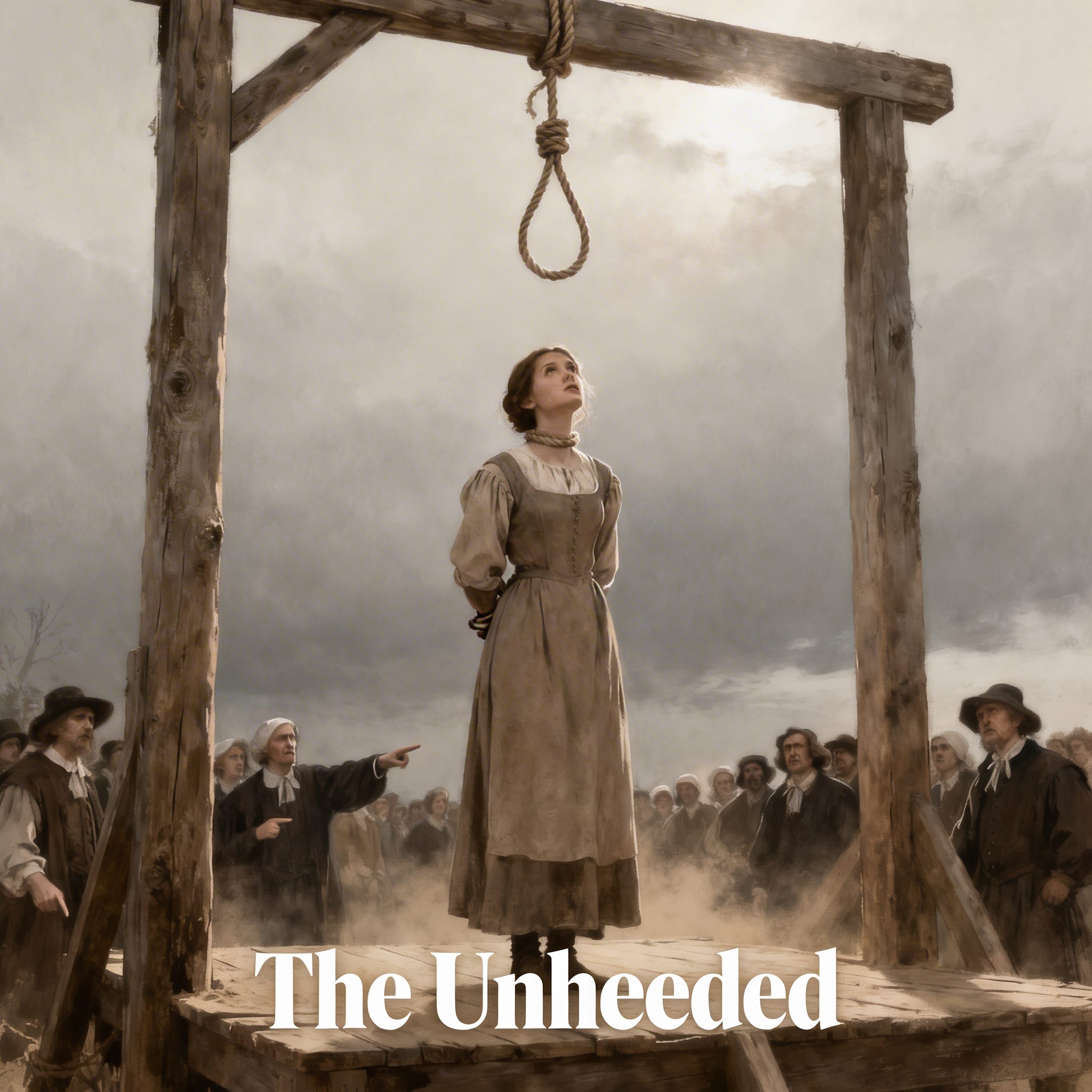
Dawn leaked a dull, bloody light over Gallows Hill, doing little to warm the air that reeked of damp wool and the sour sweat of the crowd. Cassandra stood on the warped planks of the scaffold, her wrists burning where the hemp ropes had scoured her skin raw. The noose was a cold, greasy weight against her throat, its knot a hard, unforgiving lump beneath her jaw.
Below, the faces of the villagers were a blur of grey and brown, their features hardened into a single, monstrous mask of judgment. There was Mullins the blacksmith, who’d once gifted her a honey cake on her tenth name day; only now he stared, arms crossed, his face a block of stone. There was Widow Harlow, whose fever she’d eased; her lips now pressed into a thin, self-righteous line.
The executioner, a hulk of a man smelling of stale tobacco and onions, adjusted the knot with a brutal, professional twist, grinding the rough fibers against her windpipe. A sharp splinter from the rail dug into the sole of her bare foot, a tiny, focused pain in the face of the abyss. The priest’s words were a dry rattle, a meaningless insect buzz she could no longer hear.
Her final vision was not of flowers, but of the truth: this soil, forever fertilized by innocence, would remember nothing but the sound of the drop and the silence that followed.
“Hast thee any last words?” the magistrate barked, impatient for his breakfast.
A vision seared her thoughts: centuries unspooling, seasons cycling, until the gallows lay buried beneath a carpet of wildflowers. Stone markers jutted from the soil like broken teeth, names etched by time’s patient hand: Bishop, Parker, Pudeator… all those that the village had devoured. A girl in a starched linen dress knelt there, placing snowdrops at the base of a weathered plinth. “Forgive us,” the child whispered to ghosts.
Cassandra’s lips twisted. The truth would outlive her, yes. They’d build their monuments and sing their penitent hymns. But the soil beneath her bare feet would remember the weight of her body, the crack of timber, and the way innocence could curdle into lies in the mouths of the righteous.
Cassandra’s voice was a scrap of torn cloth. “Dost thou believe the fear dies with me? It is thine legacy.”
Then, the world vanished from beneath her feet.
Epilogue: The Stones
Danvers (formerly Salem Village), MA – Present Day
Tourists cluster near a weathered monument, its inscription stark: “Victims of the Witch Trials – 1692.” A young girl pauses, tracing Cassandra Bishop’s name.
“She predicted it all,” a guide says. “They called her a witch for telling the truth.”
The wind stirs the barley fields beyond, carrying whispers only the girl hears: “Beware the fire…”
A Note from the Author’s Desk:
Cassandra of Troy’s myth mirrors the Salem tragedy: a warning ignored, truth drowned in fear. In the hush that follows, the murmur of barley and the echo of Cassandra’s warning linger as a quiet admonition to those who will listen.
The stones—silent, steadfast—bear names etched by fear, but the land itself holds memories deeper than any monument, reminding each generation that truth, once uttered, can neither be reclaimed nor erased by fire or forgetfulness.
The past persists in the air, in the earth, and in the stories that refuse to be buried, asking us to remember, to question, and to heed the lessons whispered by the restless wind.
While her character is fictional, the trials claimed twenty very real lives, their stories a testament to the cost of hysteria. This story blends myth with history and attempts to underscore the timeless peril of silencing voices that challenge collective madness.
Well, that escalated quickly! As you know, I’ve been working on this short story collection, and like a cat in a room full of laser pointers, it came together way faster than I expected.
Introducing:
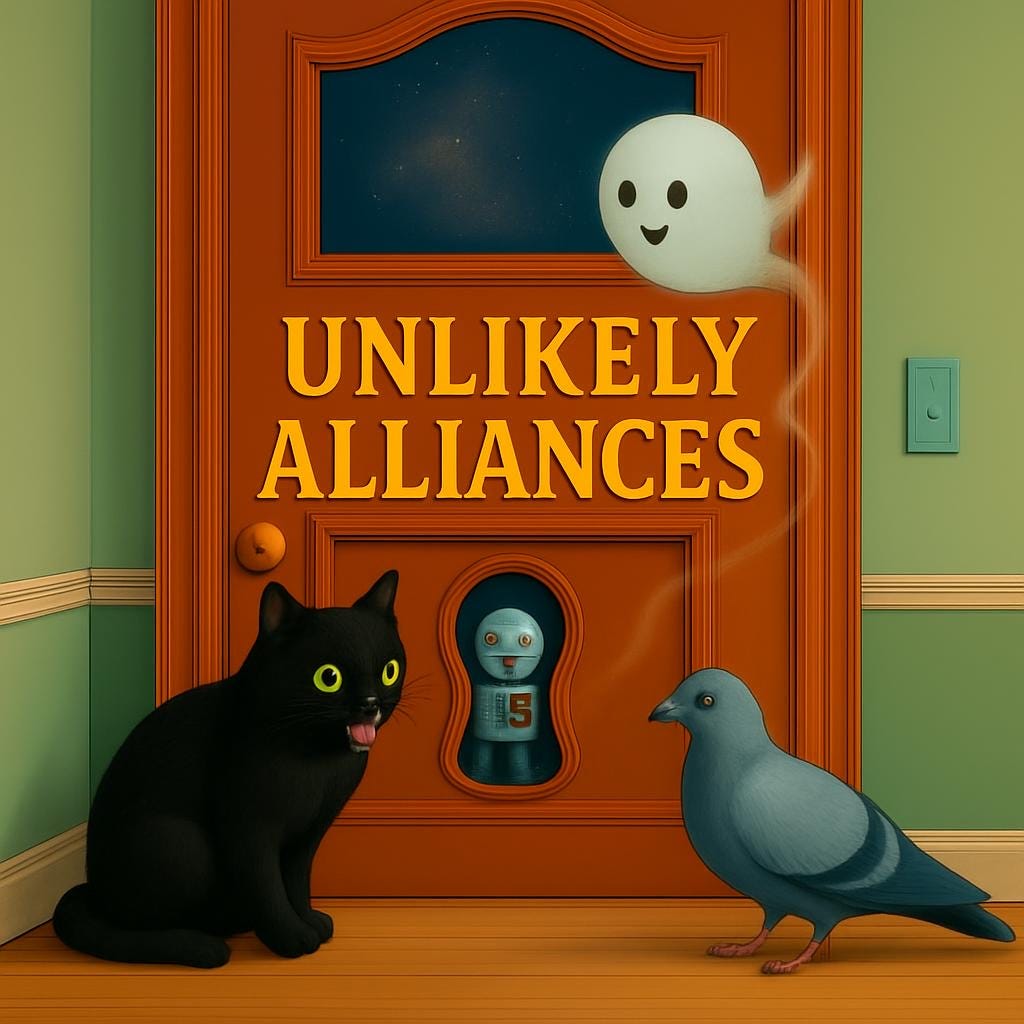
Unlikely Alliances: Strange Friendships and Other Hysterical Disasters
What happens when goblins decide to throw their lot in with suburban life, ghosts become social media stars, houseplants start sharing their unsolicited opinions, and time travel goes completely off the rails? Spoiler alert: nothing goes according to plan, which is exactly where the fun begins!
This laugh-out-loud collection of nine wildly imaginative tales explores the delightful chaos that ensues when unlikely alliances form—think a ten-year-old girl teaming up with a goblin 👹. I’m talking a sarcastic AI, a sassy fern, a cosmic freeloader, a mean girl muse, and a philosophical robot 🤖. Oh, and birds 🐦 🐦 who’ve somehow amassed way too much power.
At its core, UnlikelyAlliances is all about connection—the messy, absurd, and terrifically unexpected kind. It’s a celebration of the weird friendships that thrive when the universe decides to throw everyone a curveball. Smart, irreverent, and surprisingly heartfelt beneath the witty snark, this collection is perfect for readers who love speculative fiction that doesn’t take itself too seriously but knows exactly what it’s doing.
I’m thrilled to announce that it’s now live on various ebook platforms, but you can snag the book at Smashwords for a glorious 50% off right here:
I had a whole bunch of stories I wanted to toss into this collection, but the universe had other ideas (or maybe it was just a bad sense of timing). But fear not! I plan on assembling a future collection of even more ridiculous short stories when the stars ✨align and my schedule clears up—which, let’s be honest, is like waiting for the next ice age.
If you like your humor a bit wacky, your genre lines blurred, and your disasters gloriously hilarious, welcome aboard!
Buckle up, folks. Things are about to get weird—and I promise you’ll have a blast 💥!
If it’s worth so much to anyone to wag their tongues about what I am and what I am not, and what I say and what I don’t, then the generous thing to do would be to let them have at it.
Got questions, comments, concerns, regrets? Tell me about it: